FlatOut
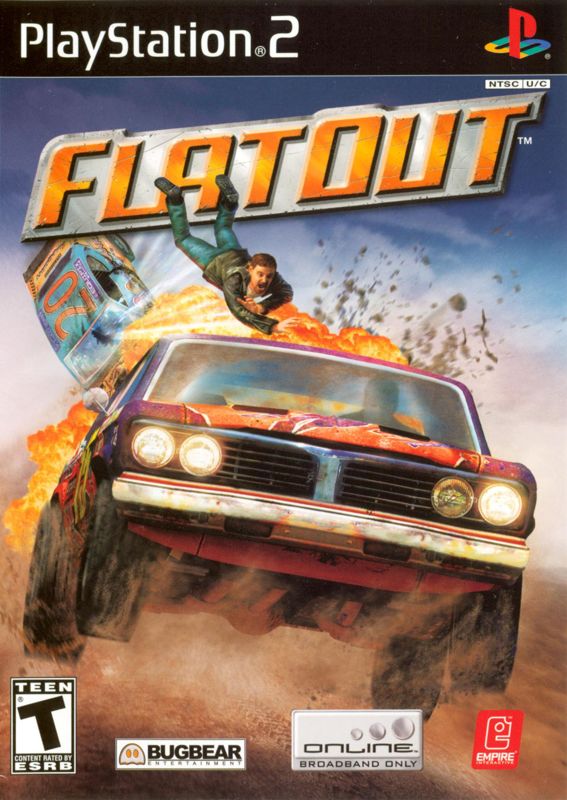

FlatOut is a driving game where crashing your car can be more fun than racing it. You drive muscle cars around dirt tracks, battle them on destruction derby arenas, and take part in Ragdoll Olympics. That last one may need some explanation. When you crash in FlatOut, your driver (the Ragdoll) is flung through the windscreen, very much like in Rekkaturvat. This feature is used in the Ragdoll sports where the task is to propel the hapless driver as far, as high, or as accurately as possible. On the demolition arena the goal is to wreck other cars before yours is. Simple as that.
The bulk of the game is racing though and it can be performed in typical quick race and time trial modes in addition to the proverbial career mode. There are also two different handling modes for the cars. Normal mode gives arcade type handling, suitable for gamepads. Professional mode seems to be designed for steering wheel owners and provides very challenging simulator-type handling. Not surprisingly since Bugbear's previous racing title Rally Trophy was considered to be very challenging, even demanding, simulation.
Bugbear's experience with simulation dynamics shows in FlatOut. Almost everything on the track can be run into and it behaves as it should in real life. Or at least as in a car-chase movie. Stuff that cars scatter around are there on the next lap too and cars are gradually dismantled when hit to other cars or solid objects around the track.
Multiplayer modes are of course great party hits. Depending on platform, FlatOut has hotseat, split screen, LAN, and/or online multiplay modes.
The bulk of the game is racing though and it can be performed in typical quick race and time trial modes in addition to the proverbial career mode. There are also two different handling modes for the cars. Normal mode gives arcade type handling, suitable for gamepads. Professional mode seems to be designed for steering wheel owners and provides very challenging simulator-type handling. Not surprisingly since Bugbear's previous racing title Rally Trophy was considered to be very challenging, even demanding, simulation.
Bugbear's experience with simulation dynamics shows in FlatOut. Almost everything on the track can be run into and it behaves as it should in real life. Or at least as in a car-chase movie. Stuff that cars scatter around are there on the next lap too and cars are gradually dismantled when hit to other cars or solid objects around the track.
Multiplayer modes are of course great party hits. Depending on platform, FlatOut has hotseat, split screen, LAN, and/or online multiplay modes.
FlatOut 2


As in FlatOut your goal is to drive as reckless as you can and still win the race. But contrary to its predecessor, FlatOut 2 is now a complete arcade-racing game.
The core of the game is the career mode which features 3 different racing-classes: Derby, Race and Street. Every class is also divided into 3 levels. You begin your career in the derby class level 1. Here you drive old, wrecked cars straight from the dump. As you progress to the race class and finally to the street class you can buy better and faster cars which you can then also tune to your needs, like installing a new engine.
Inside the classes you find different kinds of events: from normal races over Destruction Derbies to stunt events. All of the events feature a fully destructible environment. This is not only eye-candy but is also required to fill up your nitro and handicap your enemies.
If you get bored of that, you can play one of the 12 mini-games. Like in FlatOut your goal here is to do all kinds of crazy stuff with your driver. You can use him as a football, throw him through burning rings and more. These mini-games can also be played with up to 8 players on one PC in a hot-seat mode.
The core of the game is the career mode which features 3 different racing-classes: Derby, Race and Street. Every class is also divided into 3 levels. You begin your career in the derby class level 1. Here you drive old, wrecked cars straight from the dump. As you progress to the race class and finally to the street class you can buy better and faster cars which you can then also tune to your needs, like installing a new engine.
Inside the classes you find different kinds of events: from normal races over Destruction Derbies to stunt events. All of the events feature a fully destructible environment. This is not only eye-candy but is also required to fill up your nitro and handicap your enemies.
If you get bored of that, you can play one of the 12 mini-games. Like in FlatOut your goal here is to do all kinds of crazy stuff with your driver. You can use him as a football, throw him through burning rings and more. These mini-games can also be played with up to 8 players on one PC in a hot-seat mode.
FlatOut : Chaos & Destruction

FlatOut 3: Chaos & Destruction is an entry in the racing game series and the second title in the franchise developed by Team6 game studios following the Wii game FlatOut. True to the original spirit it is a fast-paced racer that also involves ramming opponents and objects in the environment combined with physics that can launch the driver through the window. The cars have a damage model that is shown as a percentage next to the visual clues.
Players can choose between 47 vehicles including monster trucks, bulldozers, tanks, and muscle cars. These can be fine-tuned and the skin can also be determined. There are twenty racers and ten main racing environments with variations for a total of 62 tracks. Compared to previous titles it is much faster and requires better reflexes to keep the car under control. Next to the main racing tracks there are stunt tracks and Destruction Derby environments for up to 24 cars in a single arena. The game can be played in split-screen or online for up to sixteen players simultaneously. New cars and courses are unlocked by performing well.
Some of the game modes include Speed where the handbrake is removed, Night Shift where the races are done in the dark with rainy and thunderous weather, Stunt Man where the driver has to be launched ragdoll-style to reach a target, Off Road, Challenge, Monster Truck (new to the series), Stunt Man, Big Battle, and Battle Arena.
Players can choose between 47 vehicles including monster trucks, bulldozers, tanks, and muscle cars. These can be fine-tuned and the skin can also be determined. There are twenty racers and ten main racing environments with variations for a total of 62 tracks. Compared to previous titles it is much faster and requires better reflexes to keep the car under control. Next to the main racing tracks there are stunt tracks and Destruction Derby environments for up to 24 cars in a single arena. The game can be played in split-screen or online for up to sixteen players simultaneously. New cars and courses are unlocked by performing well.
Some of the game modes include Speed where the handbrake is removed, Night Shift where the races are done in the dark with rainy and thunderous weather, Stunt Man where the driver has to be launched ragdoll-style to reach a target, Off Road, Challenge, Monster Truck (new to the series), Stunt Man, Big Battle, and Battle Arena.
Fleet Defender


Fleet Defender is a single player F14 combat sim with many finer details represented, including the ability to switch between the pilot and rio seats. This is the type of simulation where the player is a realistic part of a mission and not necessarily a 'rambo.'
Flight of the Amazon Queen


Joe King is the hero of this point and click adventure. His plane is carrying actress Faye Russell when it crash lands in a remote jungle, and he must battle through 100 screens of adventure and puzzle. The game's feel is influenced by hammy B-movies, and the characters are quite stereotyped and comic. As standard in point and click adventures, a set of icons at the bottom of the screen allow you to interact with visible characters and items in the main view area.